Home> Industry News> Techniques for Handling Difficult Intermittent Catheterization(2)

Techniques for Handling Difficult Intermittent Catheterization(2)

2026,03,23
Intermittent catheterization is regarded as the "gold standard" for dealing with neurogenic bladder dysfunction. During intermittent catheterization, the catheter is generally inserted smoothly, but occasionally there may be difficulties in insertion. The causes of insertion difficulties and the solutions are as follows
 
2. Standardize catheterization procedures
2.1 The selection of the catheter should be appropriate, with the right thickness. Either an overly thick or overly thin catheter will cause difficulties in insertion. An overly thick catheter is difficult to insert and is easily understood, while an overly thin catheter has insufficient hardness, is prone to bending, and is likely to form a false passage, thus causing insertion difficulties. Therefore, when choosing a catheter, one should be cautious. 
 
Regarding the selection of urinary Catheters, the European Association of Urological Nurses has provided the following recommendations based on relevant literature and practical experience:
a: For adult catheterization, the preferred catheter diameter should be 12-14 Fr.
b: For catheterization of children under 6 months of age, a 5 Fr catheter should be used.
c: For catheterization of children over 6 months of age, male children should start with 6-8 Fr, and female children with 8 Fr. The appropriate diameter should be selected based on the specific condition of the child.
d: If there are any problems during the insertion process, or if blood clots or debris (sediment) are found in the urine, it often indicates that the current diameter is not suitable. It is necessary to consult a professional doctor. 
 
2.2 The amount of lubricant used should be sufficient. For using an ultra-smooth urinary catheter, no other lubricant is required. When performing intermittent catheterization with an uncoated urinary catheter, the conventional method is to lubricate the front end of the catheter for about 5 cm. However, to avoid the occurrence of difficult insertion as much as possible, it is recommended to lubricate the entire part of the catheter that needs to be inserted. Generally, for men, the front end of the urinary catheter should be lubricated for about 25 cm, and for women, it should be lubricated for about 6 cm. 
 
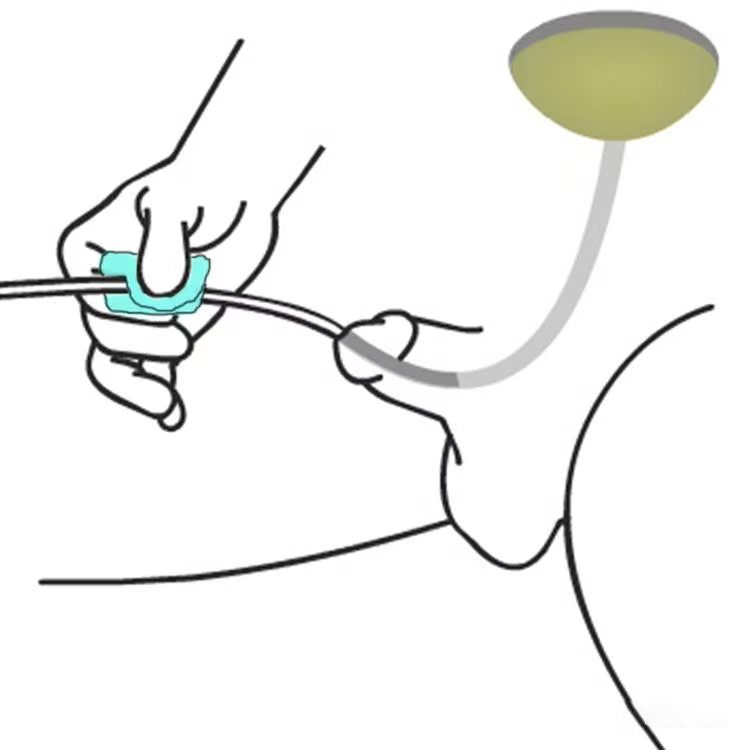
2.3 For male patients, when inserting the urinary catheter, the penis should be lifted and extended backward to eliminate the anterior pubic curvature of the urethra as much as possible. The catheter should be inserted slowly, using the conventional method where the index and middle fingers of the left hand pinch the tip of the penis and extend it backward, while the right hand holds the catheter body and slowly advances it. During the insertion, try to relax the patient's mind. If there is difficulty in inserting the catheter to the posterior urethra, manual massage in the perineum and deep pushing can be used to facilitate the insertion; if there is resistance and the catheter cannot advance when inserted into the posterior urethra, do not use force; instead, wait for a while, wait until the urethral sphincter muscle relaxes, and then continue the insertion; or appropriately adjust the insertion angle of the catheter and insert it slowly to reduce urethral injury or the formation of a false channel. 
 
 
005
 
The male urethra is long and has a smaller diameter. When the penis is not erect, it takes the shape of an "S". It has two physiological curves and three narrow sections. When inserting a urinary catheter, appropriate techniques must be used to eliminate or accommodate these physiological curves.
 
The content of this article is sourced from the internet. The author assumes no responsibility for it. Without permission, copying is strictly prohibited.
Contact Us

Author:

Ms. Aseel Yao

Phone/WhatsApp:

+86 15279557940

Popular Products
You may also like
Related Information
The difference of Latex Surgical Gloves and Latex Examination Gloves

Latex gloves are one of the protective gloves made from latex. Compared to other glove materials, latex gloves are made of softer materials, resistant to aging, environmentally friendly, and durable....

What is a Medical Three Ball Incentive Spirometer used for ?

Three Ball Incentive Spirometer is widely used in hospital and home care . One person use this Three Ball Spirometer, With the help of slow breathing to strengthen respiratory muscles, the patient...

Usage of different Sizes of Disposable Surgical Blade

Yingmed Supply Disposable Surgical Blades with different sizes. For different sizes, usually, how the doctors use ? Here please refer to below description. Whatever Stainless Steel Surgical Blade and...

The Difference of Carbon steel Surgical Blade and Stainless Steel Surgical Blade

According to the material, Yingmed supply two different Disposable Surgical Blade. One is Carbon Stainless steel, the other one is Stainless Steel. What is the difference about these two kinds...

Related Categories

Email to this supplier

Subject:
Email:
Message:

Your message must be between 20-8000 characters

  • Send Inquiry

Copyright © 2026 NINGBO YINGMED MEDICAL INSTRUMENTS CO.,LTD All rights reserved. Privacy Policy

We will contact you immediately

Fill in more information so that we can get in touch with you faster

Privacy statement: Your privacy is very important to Us. Our company promises not to disclose your personal information to any external company with out your explicit permission.

Send